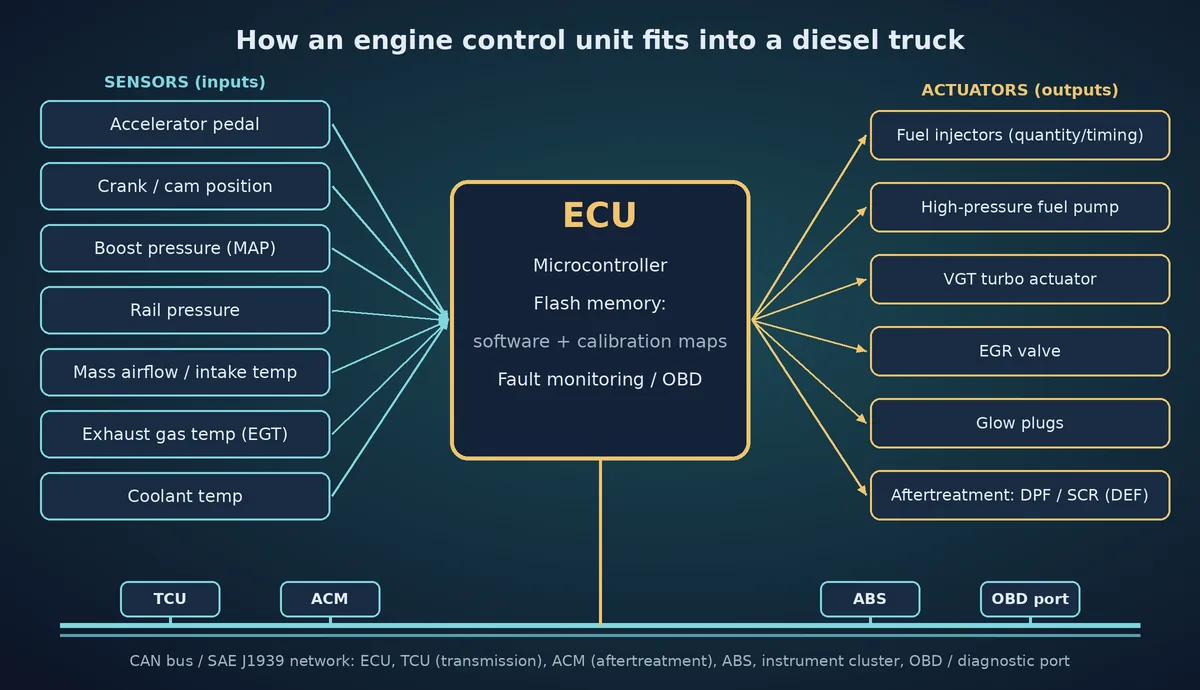
A modern diesel pickup can have dozens of electronic control units (ECUs) connected by an in-vehicle network. Vehicle programming is the work of talking to those units: reading fault codes and live data, installing software updates, setting options, and, in tuning, changing the calibration that controls how the engine and transmission behave.
Simplified view of a diesel engine ECU, its inputs and outputs, and the vehicle network. Illustration.
The control units
ECU / ECM (engine control unit or module). Reads sensors and decides how much fuel to inject, when, at what rail pressure, and how much boost to ask the turbo for. It also runs the on-board diagnostics.
TCU / TCM (transmission control unit). Decides shift points, shift firmness, torque-converter lockup, and how much torque the transmission will accept in each gear.
ACM (aftertreatment control module). On many diesels, a separate unit manages the diesel particulate filter (DPF), selective catalytic reduction (SCR), and diesel exhaust fluid (DEF) dosing.
Others. Body controllers, ABS, instrument cluster, and more. They share information with the engine and transmission.
OBD-II and diagnostics
US light-duty vehicles have had a standard OBD-II diagnostic port since the 1996 model year, with heavier vehicles phased in later. Through that port, a scan tool can read diagnostic trouble codes (DTCs), freeze-frame data, readiness monitors, and live sensor values. OBD exists mainly to make sure emissions systems keep working, which is one reason emissions law and vehicle programming are so tightly linked.
CAN bus and SAE J1939
Control units talk over a Controller Area Network (CAN), a robust two-wire bus. Pickups use CAN-based protocols similar to passenger cars. Heavy-duty trucks, buses, and a lot of agricultural and construction equipment use SAE J1939, a CAN-based standard that defines common messages for engine speed, torque, temperatures, and faults, usually through a 9-pin diagnostic connector.
Software versus calibration
The software inside an ECU has two parts. The program is the logic: the control strategies, safety checks, and diagnostics. The calibration is the data the program uses: thousands of tables (maps), curves, and single values tuned by the manufacturer for that engine, truck, and market.
A map is a lookup table. For example, a fuel map might take engine speed and pedal position as inputs and return an injection quantity. The ECU reads many such maps many times per second. Tuning is mostly about changing these tables. It's rarely about rewriting the program itself.
Three kinds of "programming"
Diagnostics: reading codes and live data to find faults. This is everyday workshop work.
Updates and configuration: installing manufacturer software updates (reflashing), programming a replacement module, or setting customer options such as tire size or, on commercial trucks, road-speed limits and idle shutdown.
Recalibration (tuning or remapping): changing the calibration to alter performance, drivability, or towing behavior. This is where legal limits matter most.
Disclaimer. This page is general educational information only. It is not professional, engineering, or legal advice, and it is not an offer to sell any product or service. Laws, product details, and prices change. Check the rules where you live and talk to a qualified technician or lawyer before modifying any vehicle. Roy's Gear is not affiliated with, sponsored by, or endorsed by Alientech or any vehicle or engine manufacturer named here. Product and platform names are used only to identify them.