Trucks are the main focus of this section, and diesel trucks are calibrated very differently from gasoline cars. A diesel has no throttle plate controlling power. Power comes from how much fuel is injected, and everything else in the calibration exists to burn that fuel cleanly and keep the engine, turbo, and drivetrain alive under heavy loads.
Read this first: diesel emissions equipment must stay intact.
US federal law (the Clean Air Act and EPA anti-tampering rules) prohibits removing, deleting, disabling, or defeating diesel emissions equipment on road vehicles: the DPF, EGR, SCR/DEF system, and their sensors and software monitors.
Selling or installing "delete" tunes or other defeat devices is also prohibited. The EPA has brought many civil cases against sellers and installers, with large civil penalties that are adjusted for inflation each year.
States such as California (CARB) add their own rules and inspections. Heavy-duty trucks in California are subject to CARB's Clean Truck Check program.
This site gives no instructions for deletes, for defeating emissions systems, or for bypassing immobilizers. Details are on the Safety and legal notes page.
How diesel calibration differs from gasoline
Fueling and injection quantity. Torque is set mostly by how many milligrams of fuel go into each cylinder per stroke. The ECU turns the driver's pedal into a torque request, then into a fuel quantity, limited by several other maps.
Rail pressure. Common-rail diesels hold fuel at very high pressure (often well over 25,000 psi) in a shared rail. Higher pressure atomizes fuel better, but the pump, injectors, and fuel system all have limits.
Boost and VGT control. Most modern truck diesels use a variable-geometry turbo (VGT). The ECU moves vanes to build boost quickly at low rpm and to protect the turbo from overspeed and excessive drive pressure. More fuel without enough air means smoke and heat.
Injection timing. Earlier injection can improve efficiency and power but raises cylinder pressure and NOx. Diesels often use several small injections per cycle to control noise and emissions.
Torque management. Trucks have layered torque limits: engine torque ceilings, gear-based torque limiters (often reduced in first gear and reverse), and limits requested by the transmission. They protect clutches, driveshafts, U-joints, and axles.
Smoke limits. A smoke limiter caps fuel based on available air (boost and airflow) so the engine doesn't send unburned fuel out the tailpipe. It protects the DPF, too.
Towing and thermal limits
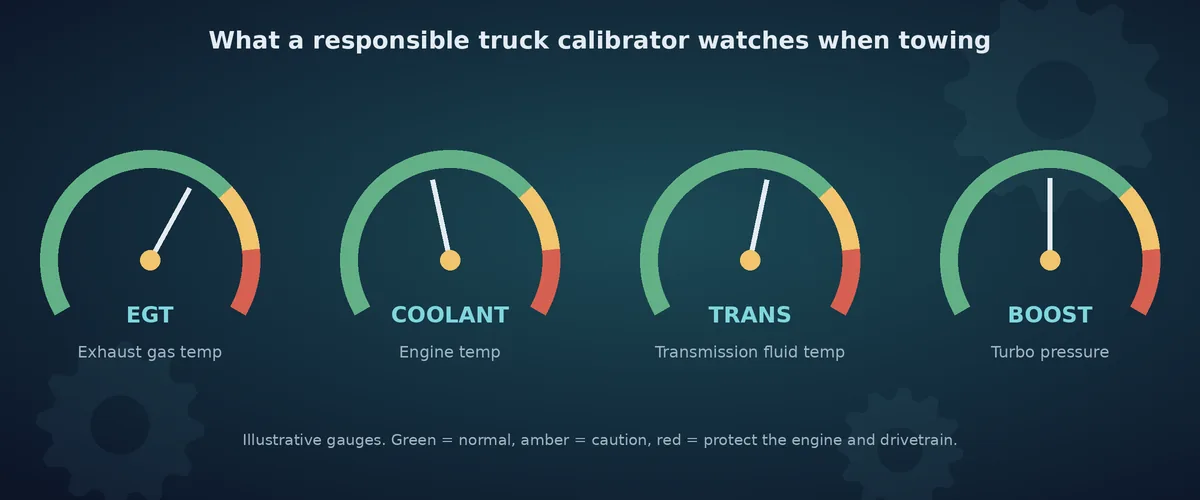
What gets watched on a long, heavy pull. Illustration.
A pickup towing a heavy trailer up a long grade in summer runs near full load for many minutes. That's where careless calibrations break things. Responsible truck calibration focuses on:
Exhaust gas temperature (EGT). Sustained high EGT damages turbos, pistons, and exhaust parts, and affects aftertreatment.
Coolant temperature. The cooling system is sized for the factory power level at the rated towing weight.
Transmission fluid temperature. Extra torque means more heat in the torque converter and clutches.
Drivetrain limits. Transmissions, transfer cases, and axles have torque ratings. Many tuners deliberately leave or restore gear-based limits so the truck survives.
Towing ratings. A recalibration doesn't change the truck's GVWR or GCWR, brakes, hitch rating, or cooling capacity. Tow within the manufacturer's ratings.
TCU calibration for towing
The transmission calibration matters as much as the engine calibration when towing. TCU changes can adjust shift points, shift firmness, converter lockup, and tow/haul mode behavior, and they can raise the torque the transmission will accept. Done carefully, that can reduce slipping and heat. Done badly, it can overload a transmission quickly. Transmission changes should match the engine's torque and the transmission's real capacity.
Heavy-duty and commercial trucks
Class 8 trucks and other commercial vehicles bring extra considerations: fuel economy per mile across a whole fleet, uptime, engine warranties and service contracts, and fleet policies. Much of the day-to-day programming on commercial trucks is legitimate parameter setting with the engine maker's own software, such as road-speed limits, cruise settings, idle shutdown timers, and PTO settings. See Truck platforms.
Disclaimer. This page is general educational information only. It is not professional, engineering, or legal advice, and it is not an offer to sell any product or service. Laws, product details, and prices change. Check the rules where you live and talk to a qualified technician or lawyer before modifying any vehicle. Roy's Gear is not affiliated with, sponsored by, or endorsed by Alientech or any vehicle or engine manufacturer named here. Product and platform names are used only to identify them.