A quick, general tour of the diesel platforms most often discussed in truck programming. Details vary by model year, engine version, and market, and the same truck can use different control units over its production run, so it's important to identify the exact ECU before any work.
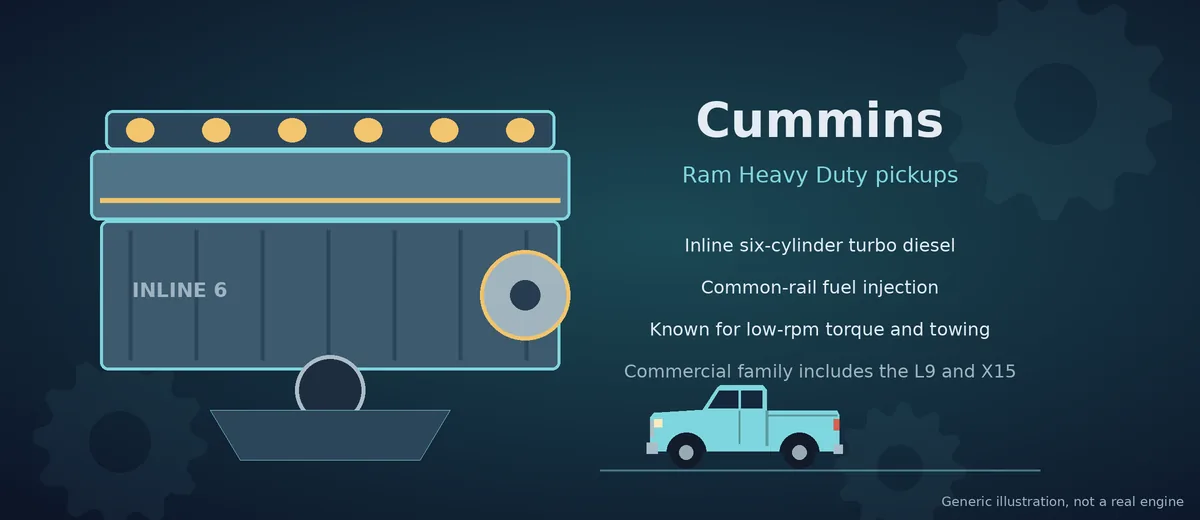
Generic illustration, not a real engine and not a manufacturer logo.
Ram's heavy-duty pickups (2500 and 3500, plus chassis cabs) have offered Cummins inline six-cylinder turbo diesels for decades, currently the 6.7 L. Inline sixes are known for strong low-rpm torque, which makes them popular for towing. They use high-pressure common-rail injection and a VGT turbo on recent versions, along with DPF, EGR, and SCR/DEF aftertreatment.
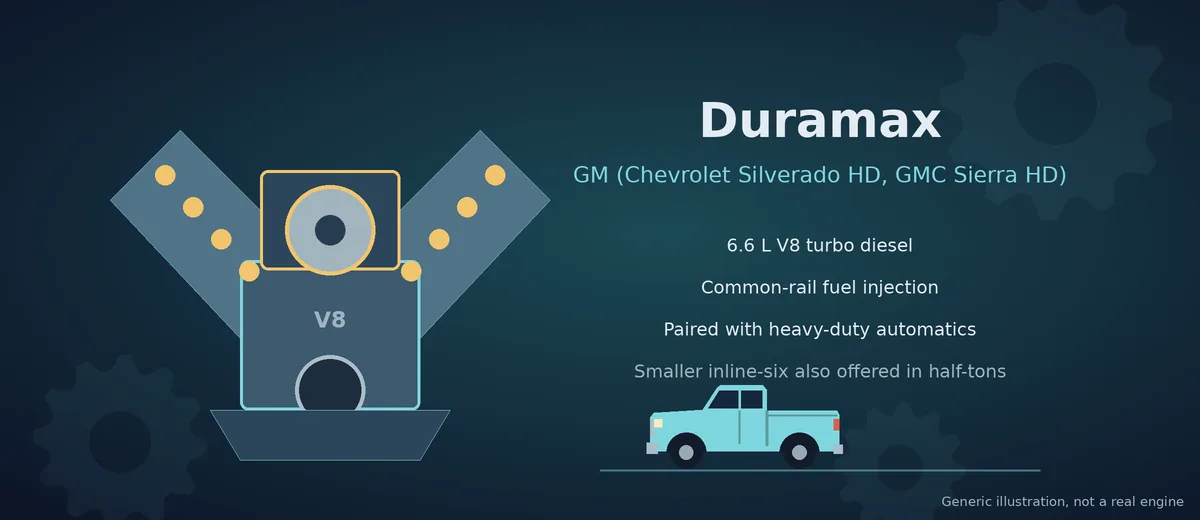
Generic illustration, not a real engine and not a manufacturer logo.
GM's Duramax 6.6 L V8 turbo diesel powers the Chevrolet Silverado HD and GMC Sierra HD. It's paired with heavy-duty automatic transmissions, so TCU calibration is a big part of any towing-focused work. GM also offers a smaller 3.0 L inline-six Duramax in its half-ton pickups.
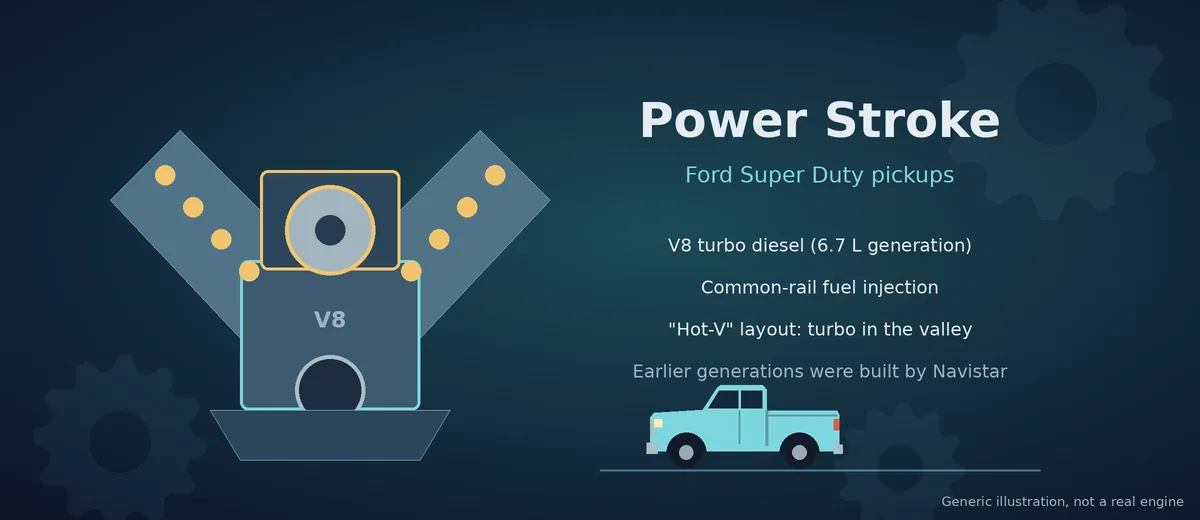
Generic illustration, not a real engine and not a manufacturer logo.
Ford's Super Duty pickups use the 6.7 L Power Stroke V8, a Ford-designed engine introduced for the 2011 model year. It has a "hot-V" layout with the turbo mounted in the valley between the cylinder banks. Earlier Power Stroke generations (7.3 L, 6.0 L, and 6.4 L) were built by Navistar.
Commercial engines communicate over SAE J1939. Engine makers supply their own service software for diagnostics and customer parameters, and fleets usually control those settings (speed limits, idle shutdown, cruise and PTO behavior) centrally. Heavy-duty engines carry the same federal anti-tampering rules as pickups, and fleets have extra reasons to stay stock: warranties, service contracts, resale value, and customer and regulatory audits.
Tractors, combines, and construction machines also use electronically controlled diesels, often over J1939. Nonroad engines are covered by their own EPA emissions standards (the Tier 4 Final generation uses DPF, EGR, and SCR/DEF much like trucks), and tampering with them is prohibited too. Recalibration of farm equipment is usually discussed in terms of power bands and fuel use, and it has the same warranty and dealer-support effects as on trucks.