ECU tuning, also called remapping or chiptuning, means changing an engine's calibration data so it behaves differently. This page explains the idea. It isn't a procedure, and results always depend on the specific engine, hardware, fuel, and the law.
The read, modify, write, test cycle
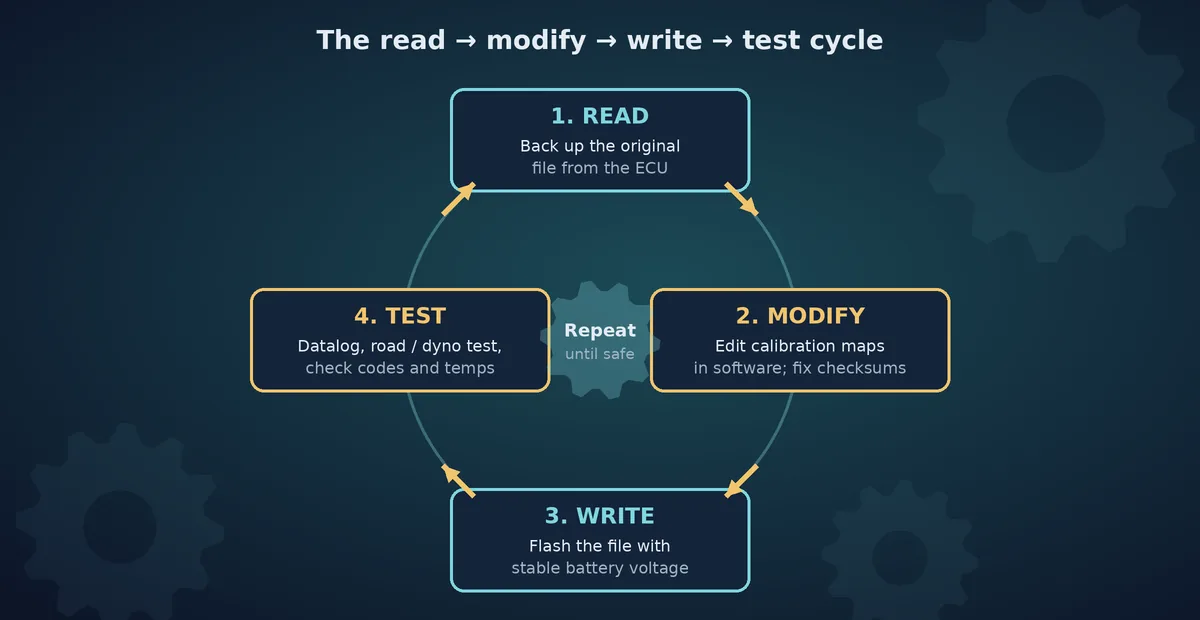
Professional tuning is an iterative loop, not a one-time download. Illustration.
Read. A programming tool reads the calibration (and often the full memory) from the control unit. The untouched original file is saved as a backup. It's the only guaranteed way back to stock.
Modify. The file is opened in map-editing software. A calibrator identifies the relevant maps and changes values within the limits of the engine and drivetrain.
Write. The modified file is flashed back to the unit. The vehicle's battery voltage has to stay stable the whole time.
Test. The vehicle is datalogged on the road or on a dyno. Codes, temperatures, and pressures are checked, and the process repeats if something needs adjusting.
The maps that matter
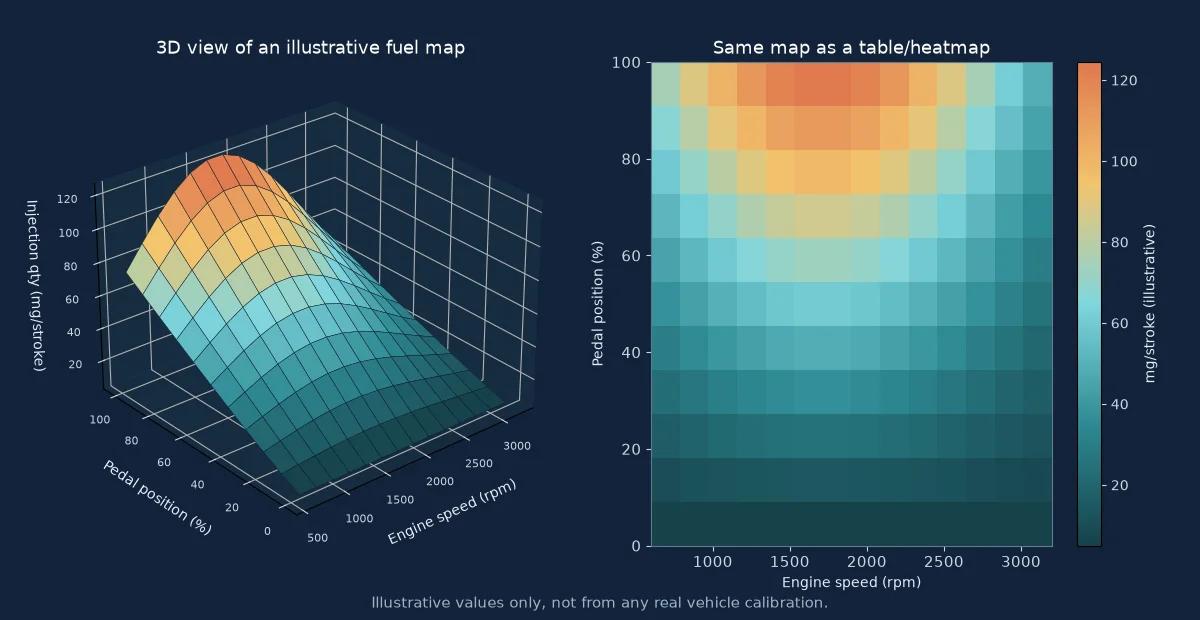
The same illustrative fuel map as a 3D surface and as a table. Values are made up.
Fuel (injection quantity or air-fuel targets). How much fuel is delivered for a given speed and load.
Ignition timing (gasoline) or injection timing (diesel). When combustion starts. Too much advance risks knock on gasoline engines and very high cylinder pressure on diesels.
Boost. The turbocharger pressure targets and the limits that protect the turbo.
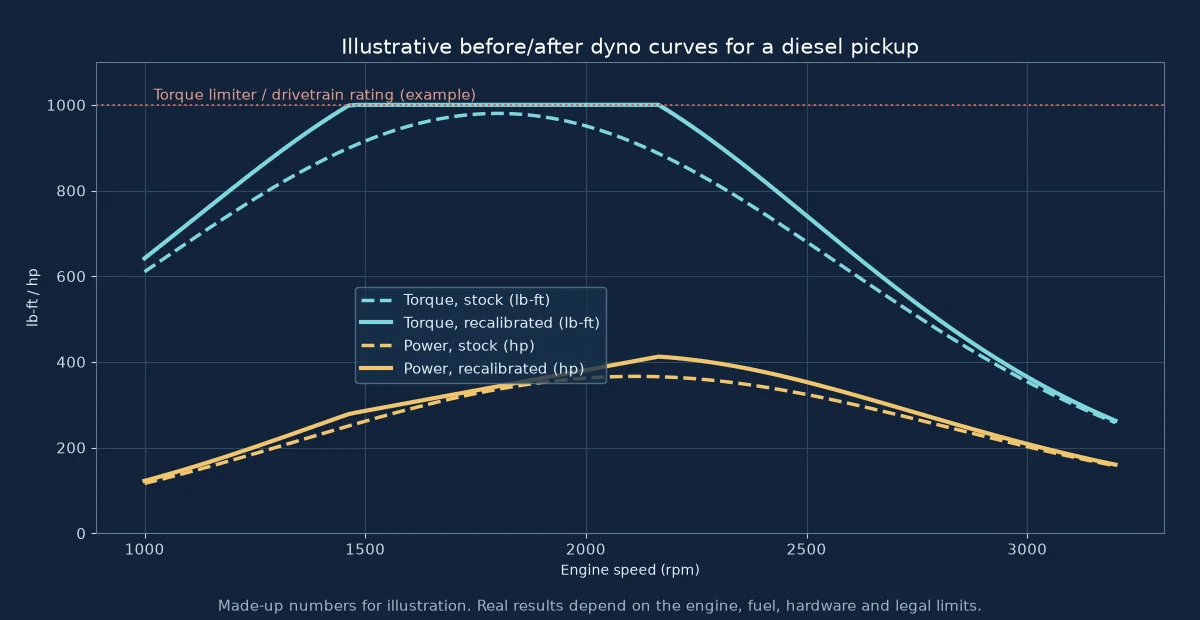
Torque limits. Ceilings on requested and delivered torque, often by gear and speed, that protect the transmission, driveline, and axles.
Limiters and protections. Rev limits, speed limits, smoke limits, and temperature-based protection. A responsible calibration keeps these working.
Connection modes: OBD, bench, and boot
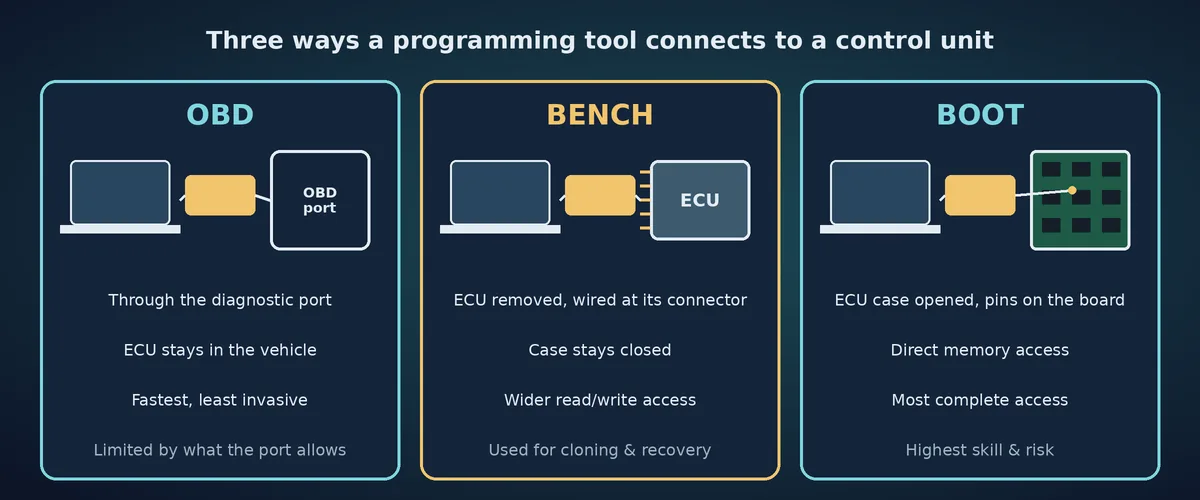
How a programming tool reaches the control unit. Illustration.
OBD. Through the diagnostic port with the ECU still in the vehicle. It's quick and non-invasive, but limited to what the ECU allows over that port.
Bench. The ECU is removed and connected at its own connector with the case closed. This often gives more complete access and is used for cloning a unit onto a replacement.
Boot. The ECU case is opened and the tool connects to the circuit board to reach internal memory directly. It gives the most complete access and is a common way to recover a unit, but it needs the most skill and carries the most risk.
Checksums and security
ECUs verify their own data. A checksum (or a stronger signature) is a value calculated from the memory contents. If the data changes and the checksum doesn't match, the ECU may refuse to start the engine or may flag a fault. Professional tools correct checksums automatically for supported units. Newer ECUs add cryptographic protection, which is one reason professional tools depend on vendor-supplied protocols and updates.
Datalogging and dyno testing
Before and after curves with made-up numbers. Note how torque is held at a limiter to protect the drivetrain.
Datalogging records live values while driving: engine speed, boost, fuel quantity, rail pressure, and temperatures. It shows whether the engine is doing what the calibration asks, and whether anything is running too hot or too lean. A dynamometer measures power and torque in controlled, repeatable conditions. Road-based measurement tools exist too, but they're more affected by weather, grade, and traffic.
A good test isn't just "more power." It also checks exhaust temperatures, coolant and transmission temperatures, smoke, drivability, and that there are no new fault codes.
Disclaimer. This page is general educational information only. It is not professional, engineering, or legal advice, and it is not an offer to sell any product or service. Laws, product details, and prices change. Check the rules where you live and talk to a qualified technician or lawyer before modifying any vehicle. Roy's Gear is not affiliated with, sponsored by, or endorsed by Alientech or any vehicle or engine manufacturer named here. Product and platform names are used only to identify them.